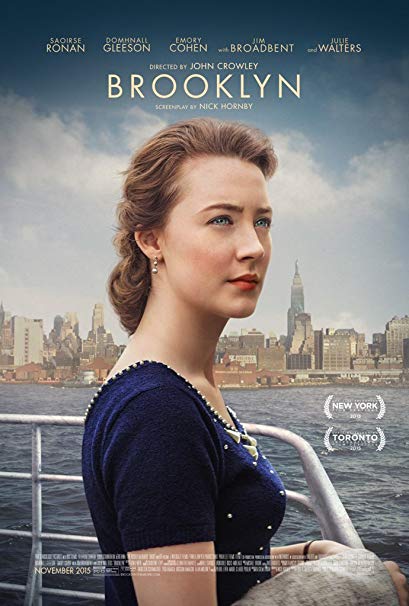
In a stunning display of writing, performance, and photography, Brooklyn (2015) will make any outsider feel perfectly at home in a movie theatre.
A simple, yet wonderfully heartfelt film about home and love, Nick Hornby turns Colm Tóibín’s novel into a cleverly articulated screenplay full of heartbreak, laughter, and romance. A story of young Irish immigrant Eilis Lacey (Saoirse Ronan), Brooklyn chronicles the struggles Eilis faces after leaving her small-town home in Ireland for a new life in New York in the early 1950s. By the skillful work of Hornby’s writing, along with John Crowley’s clever direction and stunning cinematography at the hand of Yves Belanger, Brooklyn not only impresses, but inspires. The film manages seamless transitions back and forth between Eilis in Brooklyn and her sister and mother back in Ireland; and a synesthetic experience as a young woman discovers her new home, new adventure, and love.
Ronan brilliantly maneuvers Eilis’ many emotions, from the most significant –love and homesickness– to the most nuanced of feigning interest or disinterest. The younger sibling and the only one to go off on her own to America, Eilis has to be both naive and sensible, terrified and strong. And Ronan’s pure awareness and openness expose a captivating level of acceptance and curiosity in Eilis. –In an equal curiosity, but with a unique twist on timidity, Emory Cohen’s Tony is an unexpectedly perfect match to Ronan’s Eilis. As Tony and Eilis fall –quite classically– we find ourselves rooting for these traditional lovers. So, when tragedy causes Eilis to return to Ireland, our hearts break: half left in New York and half to Ireland.
Brooklyn‘s simple and classic film elements, despite their long existence in Hollywood, are refreshing in a world of superheroes and big explosions, because they are so transparent. It is as if we’ve all been asking, “Please let a movie unravel exactly the way we imagine and hope it will.” And Hornby and Crowley simply said, “Yes… and we’ll make it good!” And we are happy to let Brooklyn do just that. A traditional moment of foreshadowing at the start of the film warns ‘don’t cause trouble,’ and designedly circles back around at the end. As it should. The gossipy young girls in the boarding house and their just-as-giddy-but-trying-to-play-it-off landlady, Mrs. Kehoe (Julie Walters), are just as giddy and gossipy as they ought to be; and played so brilliantly. Tony’s smart-alecky baby brother is exactly the youthful comedic relief we need and have missed… like a Rudy Huxtable, or Arnold from Different Strokes.
Color is one of the most memorable and significant aspects of Brooklyn, existing for more than just pleasure… although it is certainly fascinating just to look at. The colors act as metaphors and evoke emotions, rather than just resting in some nice lighting. In fact, Brooklyn lives as if your most beloved black and white film –classic and wonderful– was suddenly told in luscious technicolor. Simple things are more chromatically significant than they appear. Eilis’ vivid green coat exists almost exclusively in Ireland, only appearing briefly in America at the very start of her new life. Quickly after her arrival she assumes a vibrant red jacket instead. And as her happiness in the U.S. continues, it changes to white. And later, blue. –When transitioning back and forth between Eilis in Brooklyn and her family in Ireland, we see colors begin to change for the sake of mood. Scenes in Ireland begin to fade, literally, and lose their vibrance, while New York grows more and more colorful, paralleling Eilis’ happiness. When she is forced to return home, Eilis’ becomes the saturated, standout New Yorker in a nearly colorblind land, making her seem awkward and out-of-place in her own hometown. But the longer she remains in Ireland, the more the hues begin to mimic that of her happy times in Brooklyn –bright blues, and yellows, and reds.
Overall, Brooklyn is a detailed work of art that is aware of all its parts and makes sure to care for them. In the film Tony says, “Home is home.” But the director and screenwriter make a certain point to show that home can exist in more than one place, as many of us know to be true. Father Flood (Jim Broadbent), who helps Eilis with her new-world transition, tells her that homesickness will move on and they need Irish girls in Brooklyn; Eilis responds: “I wish that I could stop feeling that I want to be an Irish girl in Ireland.” But they’re both wrong.
What we really need are more Brooklyn‘s in Hollywood.
0